

SOFT SKILLS AND COMMUNICATION
Team Communication and Collaboration
Reduce friction, build trust and improve how your people work together: before the breakdown becomes a problem.
OVERVIEW
Most Team Problems Are Communication Problems
Teams fall apart quietly before they fall apart loudly. Misaligned expectations that nobody flags. Assumptions made instead of conversations had. Tension that builds in silence until it becomes resentment.
Most of the time the people involved are capable professionals who genuinely want to do good work. The problem is not them: it is that nobody has ever shown them how to communicate effectively under pressure.
Who Is This For?
Cross-Functional Teams
Teams that need to collaborate across departments, align priorities, improve communication and work together more effectively to achieve shared objectives.
Teams Going Through Change
Teams navigating restructure, new leadership or rapid growth where communication has not kept pace with the change.
Teams Where Communication Has Broken Down
Groups where tension, misalignment or avoided conversations are already affecting performance and need to be addressed directly.
PROGRAMME CURRICULUM
What the Team Communication Training Covers
Four modules addressing the specific communication challenges that create friction, misalignment and underperformance in teams, from feedback culture through to cross-functional collaboration.
Diagnosing Team Communication Breakdown
Before you can fix how a team communicates, you need to understand what is actually going wrong. This module builds the shared awareness of communication patterns that are holding the team back.
WHAT WE COVER
- How different personality and communication styles interact and create friction in teams
- How to use communication style frameworks (such as DiSC) to improve team dynamics
- Understanding how different communication styles interact and create misunderstanding
- Identifying the conversations the team is not having and understanding why
- Building shared language for how the team talks about communication challenges
WHAT YOU ACHIEVE
- The team develops a shared, honest picture of how they currently communicate
- Individuals understand how their own communication style affects others
- The team identifies the specific conversations they have been avoiding
Feedback Culture: Giving and Receiving Without the Personal Edge
Teams where feedback only travels downward, or where it feels personal rather than constructive, struggle to improve. This module builds a feedback culture where honesty, clarity and challenge become normal and productive.
WHAT WE COVER
- How to give feedback to colleagues in a way that is clear, specific and non-personal
- How to receive feedback without becoming defensive or shutting down
- Peer-to-peer feedback frameworks that turn observations into actionable improvement
- How to create psychological safety so feedback can travel in all directions
- How to establish team norms for when, how and why feedback is given
WHAT YOU ACHIEVE
- Team members give and receive feedback without damaging working relationships
- Feedback becomes more frequent, specific and actionable
- The team builds a culture where honest challenge is normal and expected
Cross-Functional Communication and Handoff Management
The most common place team communication breaks down is at the boundary between functions. This module builds the skills to communicate effectively across teams and through handoffs.
WHAT WE COVER
- Why cross-functional communication breaks down and where it typically fails
- How to communicate context and expectations clearly during handoffs
- How to escalate cross-functional issues without creating political tension
- How to build shared language and working agreements with other teams
- How to raise concerns about another team’s work constructively and professionally
WHAT YOU ACHIEVE
- Teams communicate clearly and consistently at functional boundaries
- Handoffs become smoother and less dependent on individual relationships
- Cross-functional issues are surfaced and resolved earlier
Meeting Effectiveness, Accountability and Follow-Through
Poor meetings are one of the biggest communication costs a team carries. This module builds the meeting discipline that produces clear decisions and consistent follow-through.
WHAT WE COVER
- How to run a meeting that produces a clear decision rather than a conversation
- Meeting roles: chair, note-taker, decision-maker and how to use them
- How to ensure accountability: assigning actions with owners and deadlines
- How to handle the meeting participant who does not follow through
- Reducing meeting overload: which conversations need a meeting and which do not
WHAT YOU ACHIEVE
- Team meetings produce clear decisions and accountable follow-through
- Meeting time is reduced without losing alignment
- The team operates a consistent accountability rhythm around agreed actions
THE APPROACH
How It Works: The 4D Model
—— STEP 01
Discover
We find out what is actually happening in your team: through interviews, observation or both. Where is the friction? What conversations are not being had? What patterns are playing out across the group?
—— STEP 02
Design
Sessions are built around what we found. The scenarios, the dynamics, the skills: all specific to your team's actual communication challenges. Not a workshop that could have been run anywhere.
—— STEP 03
Deliver
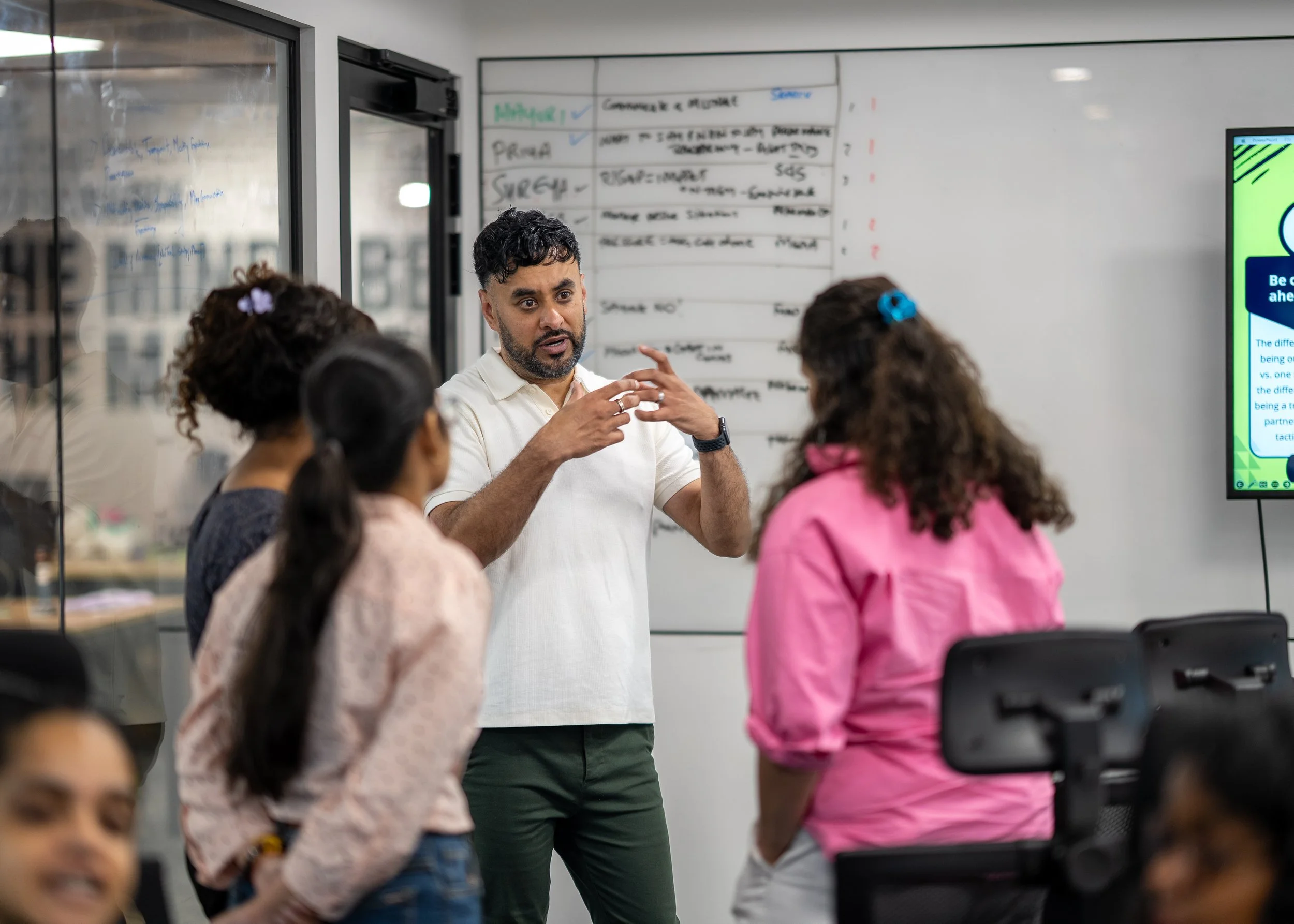
Live, face-to-face sessions. Highly participatory. The team practises real conversations in a safe environment with coaching, challenge and real-time feedback from Suk. No slides. No lecture.
—— STEP 04
Develop
Communication habits do not change after one session. The Develop phase builds in accountability: follow-up conversations, norms the team sets for itself and reinforcement over weeks and months.
WHAT YOU’LL GET
What Participants Walk Away With
86%
of employees and executives cite poor communication and collaboration as the primary cause of workplace failures
Source: Salesforce, 2024
25%
more productive are teams that communicate effectively compared to teams that do not, according to McKinsey research
Source: McKinsey and Company
£22k
estimated cost of poor communication per employee per year for UK businesses, through wasted time and rework
Source: David Grossman Research, 2023
COMMON QUESTIONS
Frequently Asked Questions
Is this the same as a team-building day?
No. Team-building days are typically one-off activities that do not address underlying communication patterns. This is structured development work: diagnosing what is actually happening and building practical skills to change it.
Can this work for remote or hybrid teams?
We deliver all sessions in-person: the quality of conversation and practice simply is not replicable remotely. For hybrid teams we recommend bringing the group together for the core sessions.
What if the communication problems are down to one or two people?
The Discover phase usually surfaces whether the issue is systemic or localised. We will be honest about what we find and design accordingly: sometimes group work, sometimes one-to-one coaching, sometimes both.
Can this run for cross-functional teams who do not normally work together?
Yes, and sometimes this is where it is most valuable. When teams have to collaborate across functions without a shared working culture, communication breaks down in predictable ways.
How long does the programme run?
It depends on what the Discover phase surfaces. A focused programme for a small team might run across 2 to 3 sessions. A larger cross-functional rollout might span 2 to 3 months.
WHAT CLIENTS SAY
Testimonials
I have had the pleasure of being on 5/6 of Suk's sessions so far since joining my new sales role. I have nothing but positive things to say about his sessions - Suk clearly is very passionate about what he does and this shows throughout his sessions. They are very interacting and highly insightful. I would recommend anyone regardless of level of experience in sales to join in on one of Suk's sessions as it is also a great opportunity to connect with people within the sales industry as his collaborative sessions allow you to speak to people within the industry with similar backgrounds to yourself.

Sam McGimpsey
System Support Manager, Altrad RMD Kwikform
First of all, Suk is a fantastic, kind and motivating person, and getting to know him has been lovely. Secondly, his knowledge, communication skills, and talent for highlighting aspects of your own strengths and blind spots are invaluable. What sets Suk apart is you can tell he truly cares on an individual level. Not only has the Sales training been vital to my own role and career, but it has been refreshing and eye-opening. It has allowed me to not only communicate better but also listen more effectively, providing tactics and practical techniques to be better and navigate challenges confidently. In the workshops through the year, Suk created an engaging and interactive atmosphere, with content that is well organised, informative, and actionable. I highly recommend Suk to anyone looking to train their teams, improve mindsets, and advance skillsets.

Isabella Harris
Business Development Executive
Over the past year I’ve had the pleasure to attend a couple of Suk’s sales courses. Suk has the ability to breakdown the theory of sales into practical scenarios which has allowed me to gain valuable knowledge and skills that I have now implemented in my current role. I’d highly recommend Suk to anyone looking to improve their sales.

Lewis Dennett
Account Manager, Paladin Sports
Build a Team That Actually Communicates Well
If friction, misalignment or avoided conversations are slowing your team down, let's talk.